Key assessment
A durable plasma requires a durable exhaust system; surface temperature, heat distribution and impurity control must be evaluated together.
The verified milestone
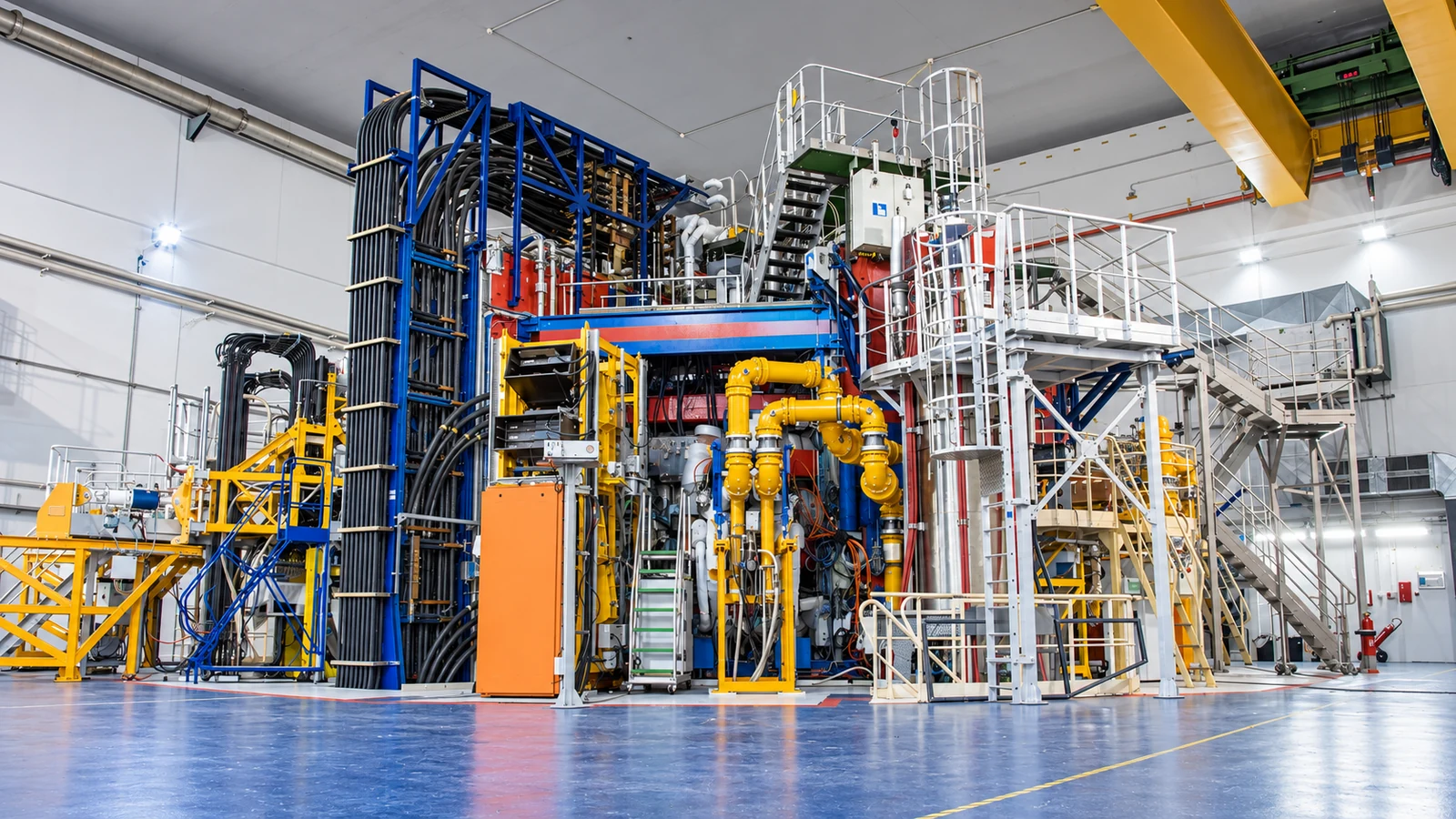
CEA reported that WEST maintained a plasma for 1,337 seconds on 12 February 2025. The announcement was published on 18 February. The March-April review window used here is an analytical grouping, not the event date. WEST is particularly relevant to engineering because its programme addresses a tungsten environment and actively cooled plasma-facing components. The record establishes duration in the reported experiment; it is not a claim of net electrical output.
The distinction makes the achievement more useful, not less impressive. A fusion programme needs machines that can investigate different constraints. A long-pulse platform can explore how heat removal, surface behaviour and plasma control interact over time, even when it is not designed to be a commercial power plant. Judging it by electricity sales would misidentify its purpose.
Sources: [1] CEA: WEST duration announcement · [2] CEA IRFM: WEST programme
Heat flux is a distribution
The engineering problem is not simply that the plasma is hot. A component experiences an incident heat flux distributed over an area and changing with time. Local peaks can matter more than the average. A design review should distinguish the power entering an exhaust region, the effective wetted area, the surface-temperature response and the coolant boundary conditions. A material melting point is only one part of that description.
Consider a deliberately simplified example: depositing 10 MW over 1 square metre gives an average of 10 MW per square metre. If the same power is concentrated over 0.5 square metre, the average doubles. This arithmetic is not a WEST measurement. It demonstrates why uncertainty in strike-point location or footprint width can be as consequential as uncertainty in total power. A control strategy must monitor both.
Why cooling does not settle every materials question
Actively cooling a surface removes heat, but the heat still crosses a chain of interfaces. Armour, joints, heat sinks, coolant channels and supports each introduce their own gradients and stresses. A component can remain below a melting temperature while accumulating fatigue or suffering damage at an interface. A meaningful qualification programme therefore measures the assembly, not just a coupon of its outer material.
We would separate a stable thermal state from acceptable lifetime. The first concerns whether temperatures stop rising under a given load. The second concerns how many operating cycles and disturbances the assembly tolerates before inspection or replacement. A short campaign can establish the first without establishing the second. That is why endurance evidence must include the loading history and post-exposure examination.
The plasma and the wall form a feedback loop
The wall is not a passive boundary. Plasma conditions influence what reaches the surface; surface behaviour can influence what returns to the plasma. A useful systems model therefore couples diagnostics of the plasma with measurements of the component. Keeping those data in separate databases may be administratively convenient, but it can hide correlations needed to interpret an event.
Our proposed review would align temperature measurements, equilibrium estimates, exhaust signals and actuator commands. We would ask whether a rising temperature followed a change in the footprint, a change in power or an instrument problem. The appropriate corrective action depends on that cause. Treating every temperature increase as a cooling failure would be as unhelpful as treating every plasma change as an unrelated physics event.
An evidence ladder for component claims
A sensible evidence ladder begins with material characterisation, continues through joined-component tests, and reaches representative integrated exposure. At each step, the test should state which boundary conditions match the intended application and which do not. ITER describes high-heat-flux testing as part of its divertor qualification approach. The broader lesson is that performance must be demonstrated against the actual combination of requirements, rather than a selectively favourable test.
For procurement, we would require a traceable component identity, loading protocol, diagnostic uncertainty and inspection outcome. A headline duration becomes much more valuable when it can be connected to a specific assembly and its condition afterwards. This also enables sensible design iteration: a changed joint or cooling geometry should not silently inherit every result obtained with an earlier configuration.
Sources: [3] ITER: divertor and high-heat-flux qualification
COTT assessment
WEST illustrates why the path to sustained fusion includes thermal engineering, diagnostics and reliability alongside confinement physics. The strongest reading of the milestone is that long-duration integrated experiments are becoming capable of probing those interactions in detail. It does not mean the wall problem is finished.
Our conclusion is to evaluate the next generation of long-pulse results through a paired envelope: plasma conditions on one axis and component conditions on the other. An operating region is credible when both remain within demonstrated limits. Electronics contributes through reliable observation and protection; materials engineering determines how much of that region can become a repeatable service.
Primary sources & method
[1] CEA: WEST duration announcement[2] CEA IRFM: WEST programme[3] ITER: divertor and high-heat-flux qualificationSources checked 2026-10-11. COTT Electronics editorial analysis of published evidence. Reported experimental results are attributed to their original teams; illustrative calculations and our assessments are identified in the text.
This is a technical editorial review, not an externally peer-reviewed paper or a report of original COTT laboratory results.