Key assessment
Density, temperature and confinement must overlap in time; a record in one parameter cannot substitute for the others.
The reported result
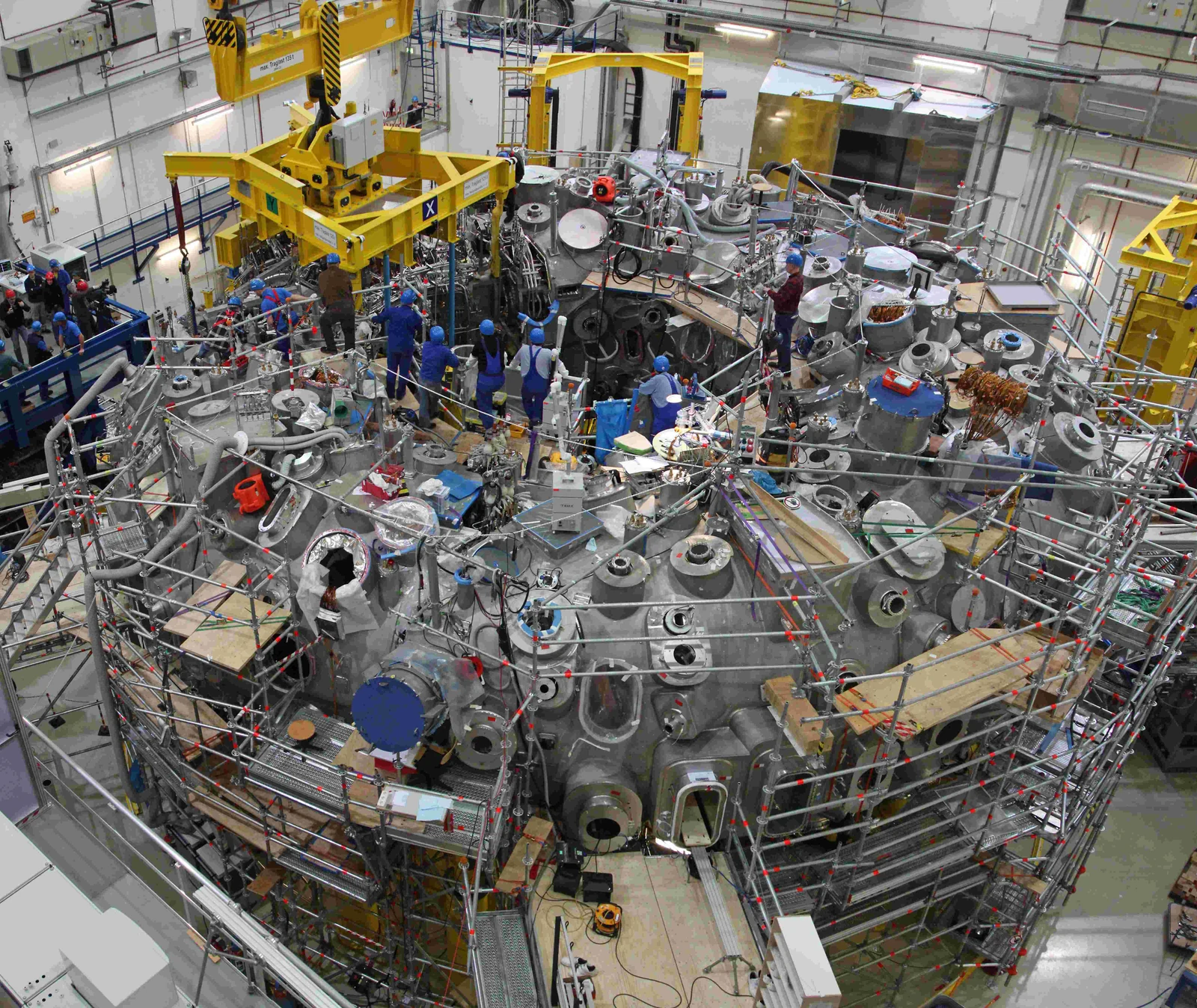
IPP announced that Wendelstein 7-X achieved a high triple product sustained over a 43-second plasma on 22 May 2025, with publication on 3 June. The institute explicitly distinguishes its long-duration result from the highest short-duration tokamak results. That qualification is important: the result should not be described as an absolute victory over every tokamak or as a power-production demonstration.
The July-August coverage label marks this review in our chronological series; it does not move the experiment into July. W7-X is an experimental stellarator. Its role is to investigate whether an optimised magnetic configuration can deliver the confinement and sustained-operation properties needed for further development. The result is most informative when read against that mission.
Sources: [1] IPP: Wendelstein 7-X performance records, including the clarification
The product is not three independent records
The fusion triple product combines density, temperature and energy-confinement time. Its interpretation depends on definitions: which temperature is used, how profiles are averaged, which density is reported and how stored energy and losses are determined. Multiplying the largest number ever measured for each parameter across unrelated shots would create a quantity no experiment achieved.
We would therefore ask for a time-resolved trace of the product and its inputs, with uncertainties and the interval over which all requirements hold. The relevant comparison is a region in performance-duration space, not simply a scalar maximum. This makes long-duration progress visible without erasing the separate value of short-duration, high-performance experiments.
Why configuration changes the control problem
A stellarator and a tokamak organise magnetic confinement differently. That difference changes the engineering trade-offs, so comparing them requires more than applying a common label. A credible review should consider how each configuration establishes and maintains its operating state, how fuelling is controlled and how heat and particles leave the system. It should also examine assembly and maintenance requirements.
Our assessment is that the useful question is not which shape wins in a photograph, but which architecture can meet a complete set of operating requirements. A configuration with a favourable sustained-plasma route may carry complexity in coil geometry or access. Another may offer a different balance. These trade-offs need quantitative evidence before they become an economic preference.
Continuous fuelling as a systems issue
IPP identifies the new pellet injector, developed by Oak Ridge National Laboratory, as an important contributor to the campaign. In the record-setting interval, approximately 90 hydrogen pellets were injected over 43 seconds. This is not merely a peripheral hardware detail: fuelling is part of the trajectory that determines whether favourable plasma parameters can persist.
For an electronics review, we would connect injector events to density response, heating and diagnostic timing. Counting delivered pellets is insufficient if their effect on the plasma is not known. The system should record commanded and observed events separately, quantify missing or delayed events and maintain an interpretable mapping between the fuelling history and the resulting state.
Sources: [1] IPP: Wendelstein 7-X performance records, including the clarification
What the record leaves to be demonstrated
A plasma-performance result does not automatically establish a reactor fuel cycle, neutron-compatible component lifetime or a commercial operating schedule. Those questions sit outside the narrow boundary of the reported experiment. They should be added to the development roadmap rather than used to deny the measured achievement. Progress is most credible when each result is attached to a specific unresolved question.
We would look next for repeated performance in a clearly defined envelope, with component conditions and operational recovery included. How often can the desired state be reached? What fraction of scheduled time is spent in that state? Which interventions are needed between experiments? The answers connect a confinement result to the reliability questions that matter in a larger system.
COTT assessment
W7-X demonstrates the value of treating sustained plasma performance as its own objective. The result supports serious investigation of stellarators, but it does not justify universal claims about plant economics. A balanced interpretation recognises both the favourable duration-performance combination and the remaining system-level qualification work.
Our conclusion is to insist on a time axis whenever a confinement milestone is presented. That one editorial choice improves scientific communication: it prevents disconnected peaks from looking like an integrated operating point, clarifies differences between machines and points directly to the next engineering test. It also makes the need for synchronized, trustworthy data acquisition explicit.
Primary sources & method
[1] IPP: Wendelstein 7-X performance records, including the clarification[2] IPP: experiment milestones and campaign chronologySources checked 2026-10-11. COTT Electronics editorial analysis of published evidence. Reported experimental results are attributed to their original teams; illustrative calculations and our assessments are identified in the text.
This is a technical editorial review, not an externally peer-reviewed paper or a report of original COTT laboratory results.