Key assessment
A gain above one is scientifically meaningful, but its denominator determines what has actually been demonstrated.
What LLNL reported
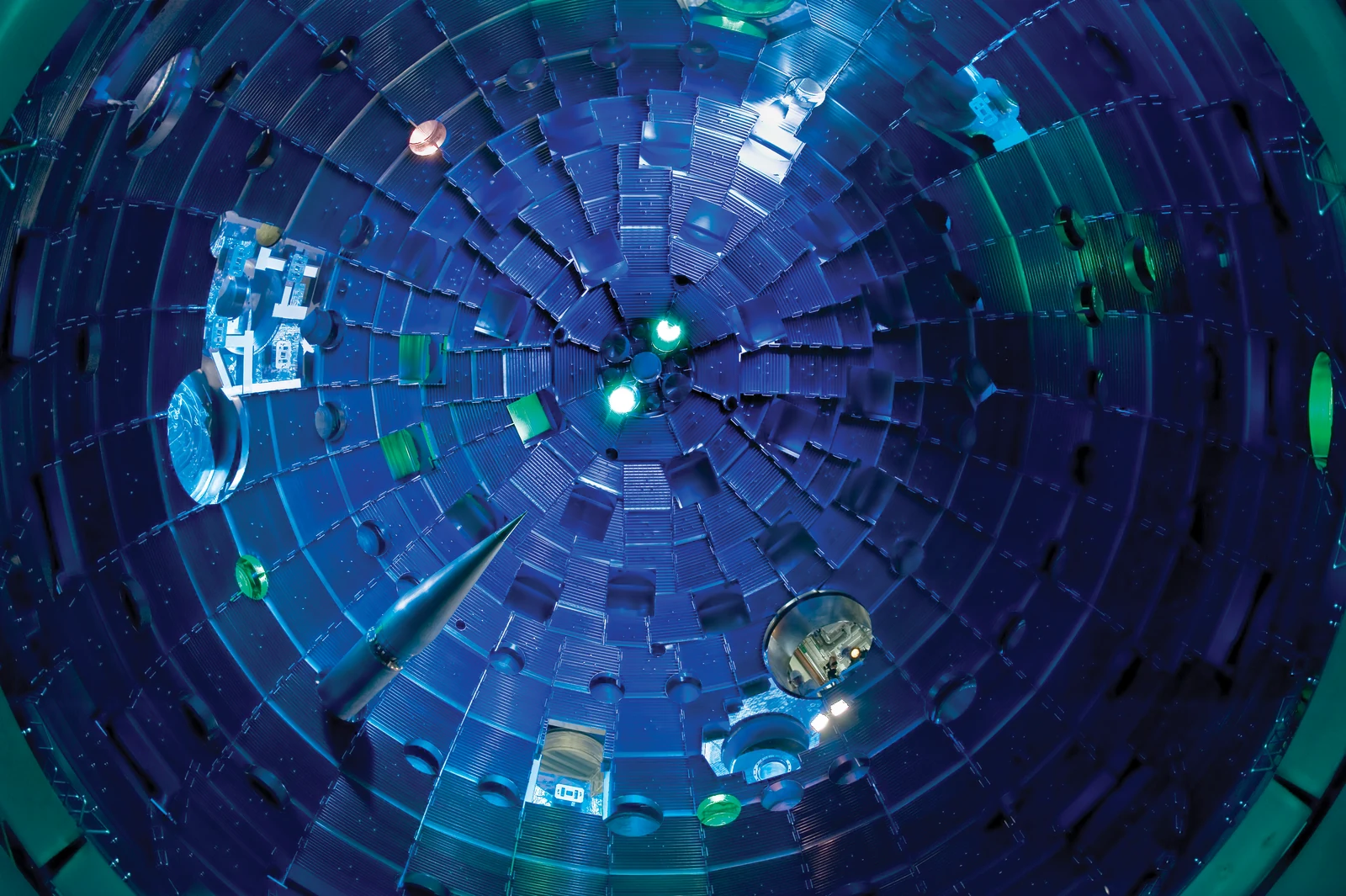
LLNL reports that the NIF experiment on 7 April 2025 produced 8.6 MJ of fusion energy from 2.08 MJ of laser energy delivered to the target. The stated target gain was 4.13. These values belong to the optical-energy boundary at the target. The laboratory also describes repeated ignition experiments, which strengthens the scientific case that ignition can be reproduced under selected conditions.
This is a result in inertial confinement, where an individual target is driven through a short, intense event. It should not be compared directly with the duration of a magnetic-confinement discharge. One quantity concerns energy released by a target; the other concerns the sustained operation of a plasma regime. Both are useful, but neither by itself gives annual electricity production.
Sources: [1] LLNL FY2025 annual report: NIF results · [2] LLNL: the future of ignition
Write the boundary before calculating the ratio
Let E_L denote optical energy delivered to a target and E_F the fusion energy released. The target gain is G = E_F / E_L. Using the reported numbers gives 8.6 / 2.08 = approximately 4.13. To estimate electricity, introduce a driver wall-plug efficiency eta_L and a thermal-to-electric conversion efficiency eta_T. A simplified per-shot balance then becomes E_net = eta_T E_F - E_L / eta_L - E_aux.
E_aux represents other electrical demands assigned to the operating cycle. The equation is deliberately a screening model: it does not resolve every route by which energy is recovered, nor specify a particular power-plant design. Its value is that it prevents an optical gain from being silently relabelled as an electrical gain. The omitted terms should be disclosed before a more detailed model is used.
An illustrative sensitivity calculation
Assume, solely for illustration, a future driver efficiency of 15%, a conversion efficiency of 40% and no auxiliary demand. These are scenario assumptions, not measured NIF efficiencies. Break-even in this simplified model requires G greater than 1 / (0.15 x 0.40), or approximately 16.7. Including auxiliary consumption would increase the requirement. A target gain of 4.13 therefore does not establish electrical break-even in that scenario.
This calculation does not predict the gain required by every inertial-fusion concept. A different driver, energy-recovery arrangement or conversion system changes the result. It does demonstrate a productive way to analyse announcements: disclose the efficiencies, compute the boundary, and test how sensitive the conclusion is to each assumption. The scientific target result remains significant even when the hypothetical plant balance is negative.
Repetition rate changes the engineering task
Per-shot energy is not power. Average fusion power depends on useful yield multiplied by the number of successful shots per second, and plant output also depends on availability. For example, a hypothetical 100 MJ yield repeated once per second corresponds to 100 MW of average fusion power before conversion and auxiliary loads. This is dimensional arithmetic, not a proposed NIF operating mode.
Repeated operation introduces a different evidence requirement: drivers, optics, target supply, chamber recovery and inspection must support the intended cycle. An impressive isolated event and a reliable sequence of events are separate achievements. An eventual commercial case should show the distribution of yields, missed shots, recovery time and maintenance interruptions, not assume that a record yield occurs in every cycle.
The right milestones for an engineering review
We would evaluate inertial-fusion progress with a matrix rather than a single gain number. Its rows would include target performance, driver efficiency, repeatability, operating cadence, component lifetime and recoverable heat. Each row would identify what has been measured, at what scale, and which boundary conditions differ from a generating plant. Dependencies between rows matter: improving one quantity may introduce a penalty elsewhere.
An optimisation that raises yield but sharply increases target complexity, for example, needs to be evaluated against manufacturability and failure probability. A driver improvement should be assessed together with optics lifetime and maintenance. This is not a reason to dismiss ambitious research; it is a way to identify where the next experiment can most effectively reduce uncertainty.
COTT assessment
NIF establishes an important scientific foundation for inertial-fusion development. Our conclusion is that the next useful public discussion should make energy boundaries explicit and connect target physics to repeatable engineering. Doing so allows the industry to recognise real progress without confusing different definitions of gain.
For electronics and computing teams, the opportunity is in measurement, synchronisation, diagnostic provenance and reproducible analysis. A plant-level assertion should only follow from plant-level evidence or a clearly labelled model with credible inputs. This article supplies an independent balance interpretation of reported results; it does not claim a new COTT ignition experiment, a peer-reviewed plant model or a demonstrated electricity system.
Primary sources & method
[1] LLNL FY2025 annual report: NIF results[2] LLNL: the future of ignition[3] LLNL: ignition experiment chronologySources checked 2026-10-11. COTT Electronics editorial analysis of published evidence. Reported experimental results are attributed to their original teams; illustrative calculations and our assessments are identified in the text.
This is a technical editorial review, not an externally peer-reviewed paper or a report of original COTT laboratory results.