Key assessment
The fuel-cycle question is a time-dependent mass balance with delays and uncertainties, not a single idealized breeding number.
The development signal
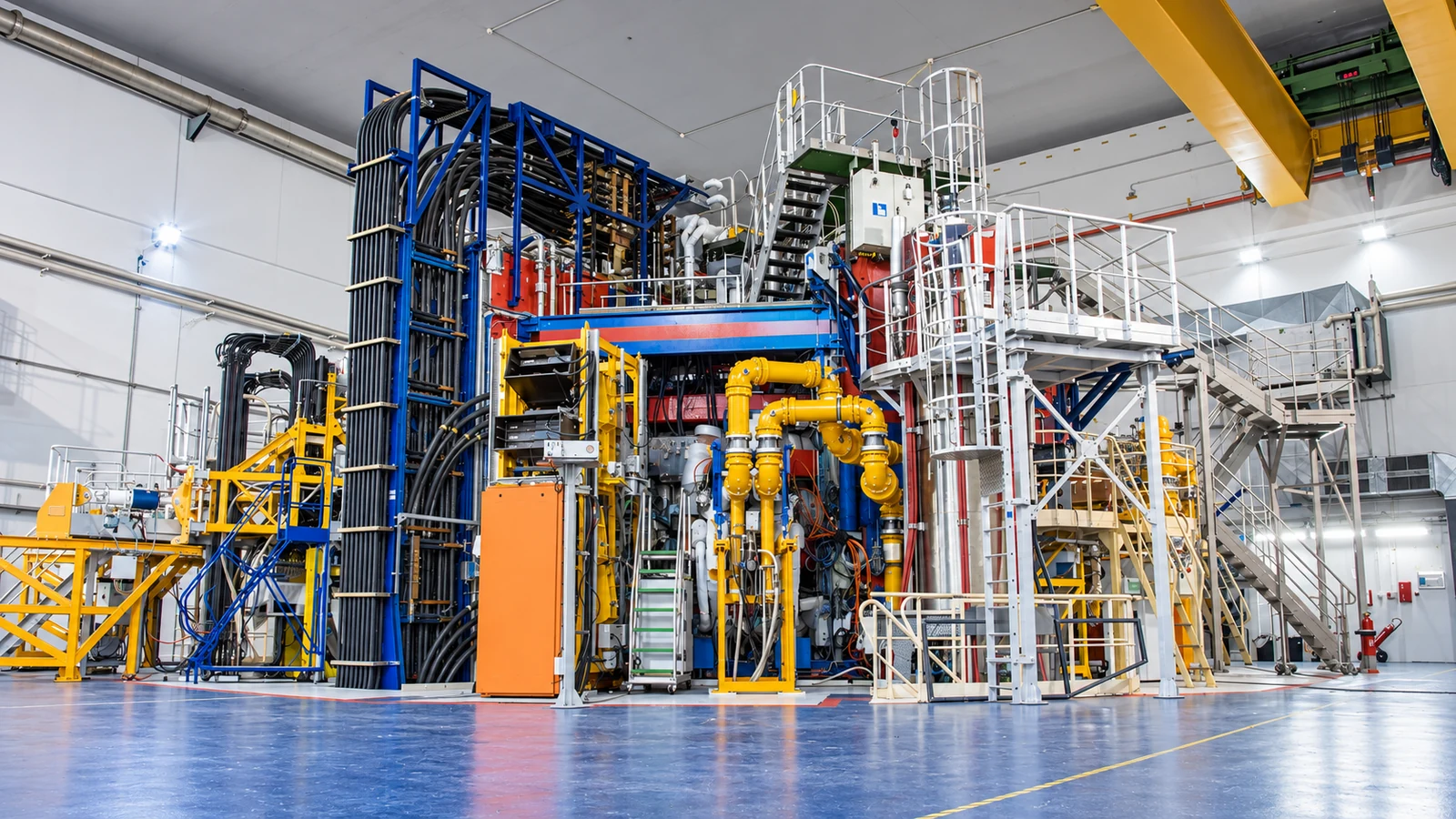
In March 2025, UKAEA and Eni announced a collaboration on the H3AT tritium-loop facility at Culham, with completion described as planned for 2028. The November-December review window reflects the place of this topic in our series, not an assertion that the facility was already operating then. The UK 2026 strategy continues to identify fuel-cycle capabilities as part of the development programme.
The significance is architectural. A generating system cannot be assessed only at the reaction site; it needs a controlled route for fuel to enter, circulate, be recovered and be accounted for. Development of an experimental loop is a step toward understanding that route, not evidence that a commercial plant has already achieved continuous fuel self-sufficiency.
Sources: [1] UKAEA: H3AT collaboration announcement, March 2025 · [2] UK Government: fusion strategy 2026
A balance with several reservoirs
A useful high-level model divides fuel inventory into reservoirs: available supply, processing, in-machine inventory, retained material and material awaiting recovery. Movement between these reservoirs takes time. A total inventory can look adequate while the immediately usable reservoir becomes insufficient. That is a scheduling and systems problem as well as a materials problem.
At the screening level, write usable inventory change as production plus recovered return minus consumption, losses and transfers into unavailable inventory. Every term needs a defined measurement boundary and time interval. This article does not prescribe fuel handling; it proposes an accounting framework for interpreting development claims. The framework should also state the uncertainty in the quantities used.
Why a breeding ratio is not the whole answer
A ratio above one can be necessary in a proposed self-supplying design without being sufficient for operation. The calculation may omit delays, inventory tied up in processing, startup needs or losses. A result obtained for an ideal geometry may also differ from one that includes access ports, structures and practical assembly constraints. The important question is which boundary the ratio describes.
An illustrative example uses only abstract inventory units. Suppose gross production is 105 units for every 100 consumed, but 8 units become unavailable over the relevant operating interval. Usable return is then 97 units, leaving a shortfall despite a gross ratio of 1.05. This is not a reactor prediction. It shows why a headline ratio should be paired with recovery and time-dependent inventory accounting.
Startup and growth require separate evidence
A single steady-operating unit and an expanding fleet impose different demands. Starting another unit can require inventory before its own operating cycle becomes established. A growth claim should therefore identify how much fuel remains available for startup while existing units continue operating. Annual production alone may conceal whether the required material is accessible at the right time.
We would ask a programme to distinguish its startup assumption, steady-operating assumption and fleet-expansion assumption. These are not interchangeable scenarios. A fuel-cycle model should show how outages, processing delays and inventory uncertainty affect each one. Reporting those sensitivities is more useful than asserting that a favourable steady-state calculation automatically supports rapid expansion.
Measurement quality becomes an operational variable
If inventory estimates carry substantial uncertainty, a control system may need a larger operating buffer. Better measurement can therefore have an economic consequence without changing the underlying reaction. The relevant electronics problem is not merely collecting more data; it is establishing a calibrated, time-aligned and auditable account of material movement.
The record should distinguish a measured transfer from an inferred transfer and preserve reconciliation differences. An unexplained residual is not safely eliminated by setting it to zero in a model. It is information about the uncertainty of the system. A useful dashboard presents that residual and the assumptions behind it so that engineering decisions are based on the actual confidence of the account.
COTT assessment
The investment in fuel-cycle test capability is a serious sign that fusion development is moving toward integrated engineering questions. Our conclusion is that the credible milestone is not simply a calculated breeding ratio, but a validated, time-dependent operating inventory with recoveries and uncertainties included.
A review should give equal attention to the route from production to usability and to the conditions of the producing component itself. This is where materials, thermal design, instrumentation and operational planning meet. The COTT perspective is a system-level interpretation of public programmes, not a claim that we operate a tritium facility or have qualified a fuel-breeding system.
Primary sources & method
[1] UKAEA: H3AT collaboration announcement, March 2025[2] UK Government: fusion strategy 2026[3] DOE: Fusion Science and Technology RoadmapSources checked 2026-10-11. COTT Electronics editorial analysis of published evidence. Reported experimental results are attributed to their original teams; illustrative calculations and our assessments are identified in the text.
This is a technical editorial review, not an externally peer-reviewed paper or a report of original COTT laboratory results.